Episode Transcript
[00:00:00] Speaker A: Foreign.
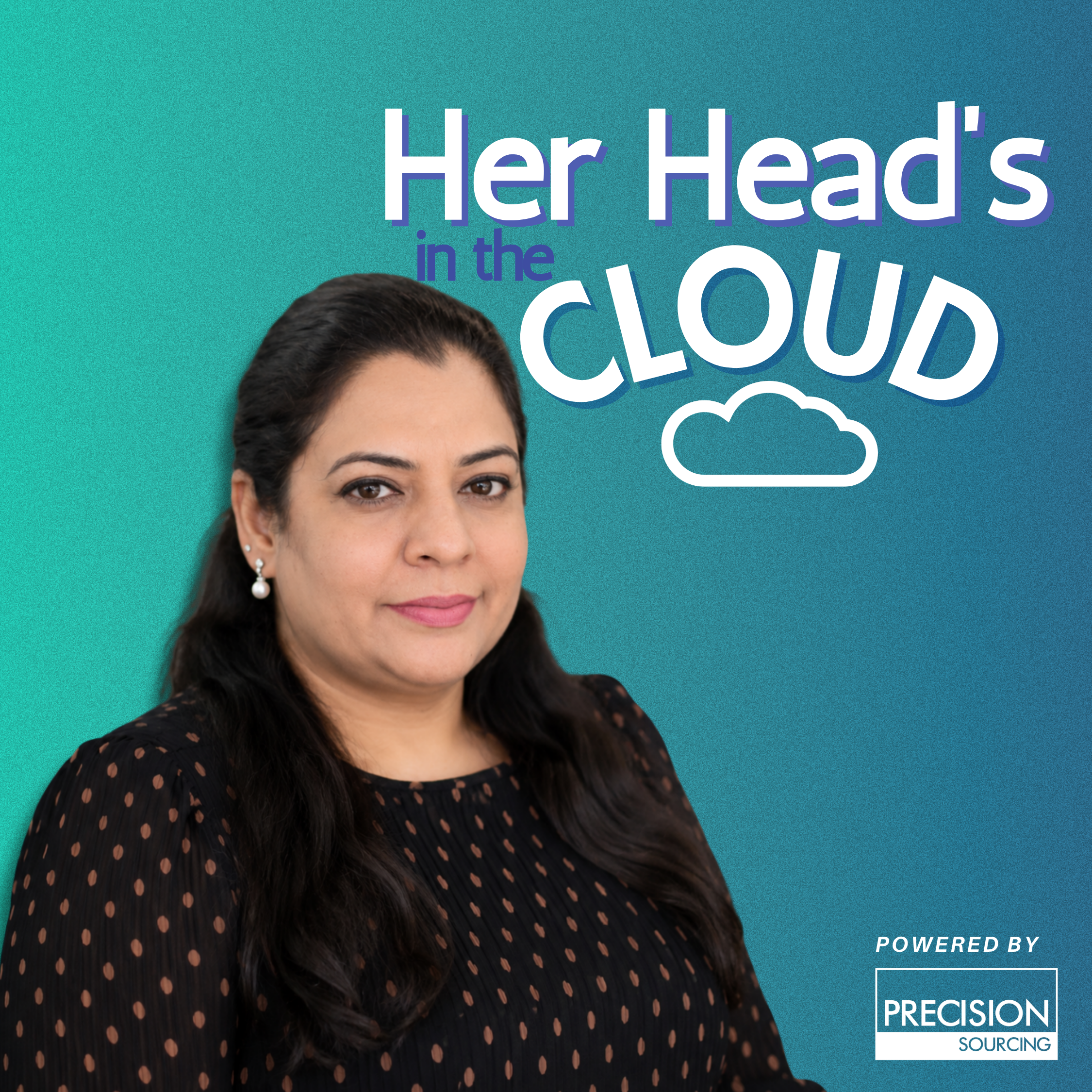
And welcome back to another episode of Her Heads in the Cloud.
Today I've got Minnie joining me from amp.
So very excited to have you here, Minnie. I'll let you do a little bit of a deep dive introduction.
[00:00:24] Speaker B: Likewise. Thank you for having me.
So. So my name is Minnie Mole. I have about more than two decades of experience in various infrastructure technologies, primarily networking, security and cloud, and it's been quite of a ride, quite of a journey for me right now. I work for a financial organization and it's really exciting to be here and, you know, share my thoughts on some of these topics that we have lined up for today.
[00:00:56] Speaker A: Yes, absolutely. And I know previously when we've spoken, Minnie, you mentioned you've never really had imposter syndrome, which I think is quite special in itself.
And why do you think that is?
[00:01:09] Speaker B: Well, I would not say that I'm not doubted myself, especially when I was trying to learn something new or trying to get into, you know, bigger roles.
[00:01:20] Speaker A: Yeah.
[00:01:20] Speaker B: But I've never labeled that as imposter syndrome.
I've always taken that as an opportunity to grow.
And one of my focus throughout the years has been to deliver consistently, and I think that has helped me. And, you know, as you gain experience and as you grow into different roles and leadership positions, you realize that it's just about the learning and the impact that you create. It's not about really proving yourself, but it's about the impact that you create. And it's evident from your work and your, you know, knowledge that you have. So I've always believed in that.
[00:01:59] Speaker A: Absolutely.
And I guess when people give you kudos for the impact that you're having, it builds that confidence even more. So.
Yeah.
[00:02:07] Speaker B: Another point is that I, by doing that, I think I built quite confident.
[00:02:15] Speaker A: Yeah.
[00:02:15] Speaker B: Like a quite confidence.
Just because I think that I don't know it all.
[00:02:22] Speaker A: Yeah.
[00:02:22] Speaker B: But I know that I'll be able to figure out. So as. As long as you know and as long as you have that confidence, I think that really works and it has worked out in my favor.
[00:02:32] Speaker A: Yeah. Yeah. A bit of a test trial. You figure it out. That's a good mentality to have.
[00:02:36] Speaker B: Absolutely.
[00:02:38] Speaker A: Awesome. And have you ever felt like you've had to prove yourself more so than others being in the industry that you're in?
[00:02:47] Speaker B: Well, early in my career, yes.
And I did have my moments where I felt that way.
Especially when you're into environments where there are very few women and sometimes you are the youngest one and there's a quiet expectation that, you know, you have to really prove yourself or, you know, you have to prove your credibility. So. So I have been in those situations, but in situations like that, I let my knowledge do the work and I usually wait for the right moment, I analyze the situation around me and I'm known for my calmness. So I leverage my strengths and I provide inputs, I provide my suggestions and I challenge approaches.
Um, and, you know, just letting them know that there are other experts in the field and, you know, not just some that are deemed so. Yeah, so I have my own coping mechanisms. I. I still see that happening though.
[00:03:56] Speaker A: Yeah.
[00:03:58] Speaker B: In fact, last week I was in an event and there was someone sitting next to me who was like a product owner, right. For a technical team, and they were talking about a technical topic and I, I just interrupted them because I had a question and I was like, I tried to pause them and they were like, oh, sorry, I. I thought I was being too technical and I was like, yeah.
[00:04:26] Speaker A: Oh, really?
[00:04:27] Speaker B: My question is technical because, you know, they, they have that assumption, it's like quiet assumption in the industry, especially in the field where I'm from, in the infrastructure field, where you see very few women or where there is a lack of diversity altogether.
But yeah, once you start sharing what you know, once they know that what they know is at par with your knowledge or maybe more so, you definitely see a change in the environment.
[00:05:01] Speaker A: It's definitely powerful to be able to create that change and impact. And when people expect something different and yeah, what you bring to the table comes as a surprise.
[00:05:11] Speaker B: Absolutely. Yeah. Yeah.
[00:05:14] Speaker A: And why do you think that more women aren't necessarily entering the networking space specifically even? It's a field that I've been working in and recruiting in, and it is a minority and it always has been.
[00:05:29] Speaker B: Yeah, well, I have to go a little bit back in time to explain that. So I think traditionally networking has been known to be very hardware focused and very rigid, but it's not the same anymore. And I think just because people still perceive it as very traditional, we still see that challenge. But if you think about the reality of today, and if you see how technologies are evolving and how networking and overall infrastructure plays a role, it's very different.
In my view, networking today sits at the intersection of cloud, AI, security and a number of other technologies.
It's at the core and it's super critical. It's a very critical element that sits at the core.
And I believe it's just about visibility and storytelling.
It's about changing the narrative. And I believe that when the narrative changes, we'll see more and more women coming in. Yeah, but, yeah, I'm still keeping myself hopeful that it'll happen soon, but 100%.
[00:06:40] Speaker A: I feel like when you do encompass those other areas, like you mentioned, AI, cloud, networking, then it almost seems like it's more of an approachable area. So hopefully, as time goes on, women won't necessarily just see it as networking, but encompasses. Yeah. A variety of things.
And what would you say the most memorable moment where someone clearly didn't expect you to know your stuff would be over your two decades of experience?
[00:07:08] Speaker B: Yeah, it used to happen quite a lot in the past and I've had those moments, like I said, early in my career, a lot because 20 years ago, at least, I didn't see any network engineers, but 20 years ago there were none. Probably I can say that safely because I've led teams, I have tried to hire teams or diverse talent in the past and I've had very little luck doing that.
But, yeah, there were moments where, and I'll give you a generic example, where teams were trying to resolve a complex problem where there is a lot of high visibility. And when I chimed in, I was like, oh, are you from that team? I was like, yeah.
So, right. So going back to my previous approach that, you know, I usually like to listen in and observe very carefully and then provide my inputs. And, you know, I firmly believe that you don't have to be the first one to speak up in a meeting.
You just have to make sense, you know, for people to perceive you differently. And the moment you start making sense. And going back to my previous example of the event that I was in last week, that was a great example of when I recently observed something like that. Yeah, your knowledge does the talking and I think that's all you need.
So that's what I usually follow. And like I said, it has reduced. I don't see that happening quite a lot as much. Yeah, but it, it does. It's still there. Yeah, but that, you know, quite. Bias is still there.
[00:08:49] Speaker A: Yeah. I feel like you're well positioned in the market to have that internal confidence that you had and you've built and developed over the years.
[00:08:57] Speaker B: Yep.
[00:08:59] Speaker A: And what do you think has kept you in NETworking for over 20 years now when quite a lot of people, I suppose, pivot out and go into a different direction?
[00:09:10] Speaker B: Well, for me, the answer is quite simple, that networking has never stayed the same.
It's so evolving and it has evolved a lot over the years and just want to highlight that my role has now become wider. It's not just into networking, but it's into a lot of other infrastructure related technologies. But I did start as a network and security engineer many years ago and that's why I can say that how it has evolved over a period of time. For example, we have moved from traditional networking to SD WAN to sase and now we are seeing these intent based systems and cloud native technologies and you know, AI based systems coming into play. So it has definitely evolved and that has. What kept me going in this domain and in this industry is that there are new challenges to solve every other day.
[00:10:06] Speaker A: Yeah.
[00:10:06] Speaker B: And there are complex challenges and they lay the foundation of any transformation project that you do.
[00:10:13] Speaker A: Yeah.
[00:10:14] Speaker B: So any critical project that I've ever worked on, it had a solid networking element or a solid infrastructure element which was a part of it and built into it.
So that is what keeps me really excited about what's coming next and you know, gets me going.
[00:10:31] Speaker A: Absolutely. And do you think from how I guess NETWORKING was say 20 years ago or slightly more legacy and now there's obviously more of like a modernized way of networking and cloud networking. Do you think companies that are, I suppose, scared of change and if they are keeping more legacy networking, do you think they can really strive or do you think companies should adopt a slightly more modern way?
[00:10:58] Speaker B: It totally depends on the business that you're running and the risks that you're ready to take.
[00:11:02] Speaker A: Yeah.
[00:11:03] Speaker B: Right.
So for example, in my industry, in the financial industry, we, we are very careful about what we do, but we also also want to make sure that we are running our environments on modern systems and we are, you know, we are there in terms of technology.
[00:11:24] Speaker A: Yeah.
[00:11:25] Speaker B: Because we cannot really run on legacy systems. But then a lot of other companies, they cannot take that risk because they're running critical payloads or critical data is being stored in those legacy systems. And just the effort of moving something from A to B and the cost of doing that is not something that they are ready to take.
[00:11:48] Speaker A: Yeah.
[00:11:48] Speaker B: So it totally depends on the business, like I said and you know, your risk appetite and what the, what your goals are with your business.
[00:11:57] Speaker A: Yeah.
[00:11:58] Speaker B: If you ask me as a technologist, I would like to modernize and you know, gain that experience and you know, be at par with, with the current industry or where we are heading.
[00:12:09] Speaker A: Yeah, absolutely. And if I can ask for your personal take, do you think AI and networking go hand in hand? What do you think the future holds of those two combined together?
[00:12:22] Speaker B: Absolutely. So AI in itself, I think it's basically the simple answer is that they abstract each other.
So networking is a critical component to run any AI related systems. It sits on AI sits on top of that networking layer.
So it's going to be there, it's going to be there in partnership with what we're building. But we just need to see how we modernize those systems or the underlying technologies, how do we make sure that they are scalable to, you know, cope up with that demand that's, you know, coming our way.
[00:13:01] Speaker A: Yeah.
[00:13:02] Speaker B: So it's not something that can be separated but they have to go hand in hand.
[00:13:05] Speaker A: Yeah.
[00:13:05] Speaker B: And we just have to understand the requirements of the technologies better and be ready for it.
[00:13:10] Speaker A: Yeah, absolutely. It's an exciting time as it evolves.
[00:13:14] Speaker B: Absolutely. Yeah.
[00:13:15] Speaker A: Awesome. Well, thank you so much for joining us today Minnie and for sharing all of your insights across the infrastructure and networking space and thank you guys for listening.
[00:13:27] Speaker B: Thank you. It's a pleasure being here.